


After 25 years of helping people lose weight, first through surgery, now through GLP-1 therapy, I’ve seen thousands of transformations. I’ve also seen people struggle unnecessarily, convinced the medication “doesn’t work for them” or that they “can’t tolerate it.” Here’s what I know: GLP-1s are remarkably effective when dosed correctly. The problem? Most people aren’t getting the dosing guidance they need.
Let me explain what success with GLP-1 therapy actually looks like, and more importantly, how to achieve it.
Understanding the Green Zone
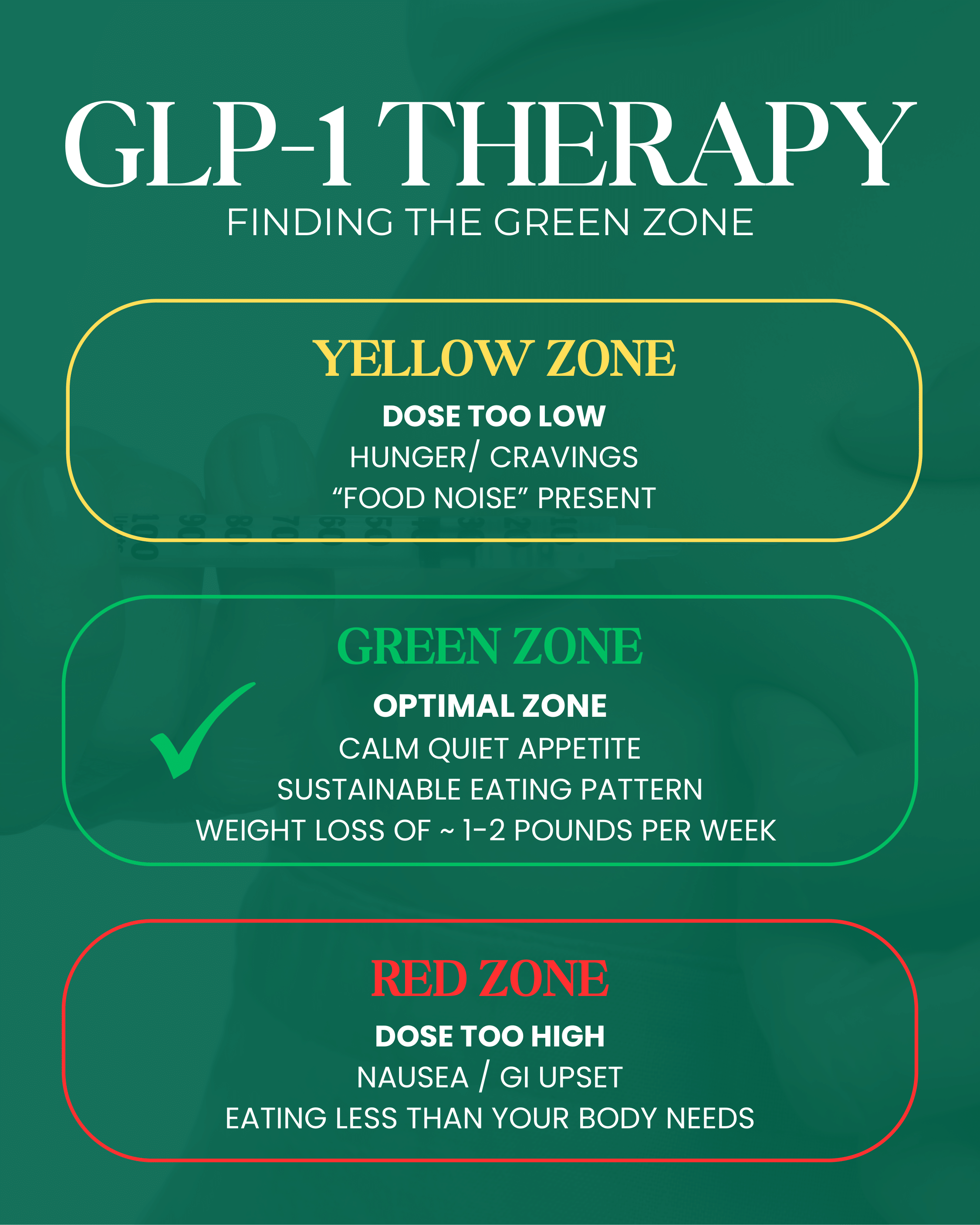
We use a simple visual (see below) with our patients: a scale with three zones: yellow, green, and red. It’s straightforward, but it changes everything.
The Yellow Zone means you’re under-dosed. You still have constant hunger. The cravings haven’t stopped. That mental noise around food, what we call “food noise,” is still there. You’re thinking about eating all the time, captivated by thoughts of your next meal. You might be on a GLP-1, but you’re not experiencing the breakthrough these medications can provide.
The Red Zone means you’ve gone too high too fast. You’re nauseated, feeling sick, maybe not eating at all because you physically can’t. This is where people often say, “I can’t tolerate GLP-1s.” But here’s the truth: you’re not intolerant to the medication. You’re intolerant to that particular dose.
The Green Zone is where the magic happens. And it’s actually a wide zone, not some precise point you have to hit perfectly. When you’re in the green zone, the food noise disappears. That constant mental chatter about what you’re going to eat, when you’re eating next, what you’re craving—it just quiets down. Your old hunger drive isn’t controlling you anymore. When you do eat, you fill up on a surprisingly small amount. And you’re losing weight steadily, typically one to two pounds per week, though that depends entirely on your starting point and goals.
Why Personalization Matters
Here’s where most GLP-1 programs get it wrong: they treat dosing like it’s one-size-fits-all.
If you’re 15 pounds overweight, losing one to two pounds weekly is excellent progress. If you’re 120 pounds overweight, that same rate isn’t going to cut it. We need to optimize your dose to speed things up safely. You could weigh 400 pounds and respond beautifully to a relatively low dose for months. Or you might need to lose 18 pounds and find that starter dose doesn’t do much for you at all.
Every body is different. Every patient requires customized care. This is why the subscription model frustrates me. Companies celebrate making a sale, but nobody’s actually taking care of that patient. You’ve just been handed a year’s supply of something without the ongoing guidance to use it effectively.
At YourEra, we’ve built something different. Our nationwide network of experienced physicians and nurse practitioners can dedicate real time to your care. They monitor how you’re responding, adjust your dosing as needed, and help you navigate the journey from that first dose all the way through maintenance. This isn’t about selling you medication. It’s about partnering with you on a complete health transformation.
The Dosing Journey: What to Expect
GLP-1 medications require adjustment over time. You don’t just find your dose and stay there forever. These medications develop what we call tachyphylaxis: your body becomes less sensitive to a particular dose over time. This happens both at the brain level, where the medication reduces hunger and cravings, and in your digestive system, where it slows gastric emptying to help you feel full faster.
This means your dose needs to increase gradually as your body adapts. It’s not a failure of the medication or your willpower. It’s simply how these medications work. The key is having a physician or medical team who understands this, monitors your progress, and adjusts accordingly.
And here’s something else most programs won’t tell you: what happens when you reach your goal weight matters just as much as getting there. Research shows that stopping GLP-1 therapy abruptly almost always leads to weight regain. In the STEP-1 trial, participants who stopped semaglutide regained two-thirds of their weight loss within one year. That’s why maintenance dosing is critical.
At YourEra, we work with you to find the lowest effective maintenance dose that prevents hunger and weight regain. For some patients, that might mean reducing frequency to every other week. For others, it’s finding that sweet spot where you’re using minimal medication while still supporting appetite control and metabolic stability. This transition requires careful medical supervision, something our network of physicians is specifically trained to provide.
Why Most Providers Miss the Mark
You might be wondering: if dosing is this critical, why isn’t everyone getting it right?
Two main reasons. First, our fee-for-service healthcare system doesn’t reward time spent with patients. Most doctors have seven minutes per appointment and need to see twelve patients an hour to keep their practice viable. They don’t have time for the conversations needed to properly manage GLP-1 therapy, to ask how you’re feeling, what symptoms you’re experiencing, whether you’re in the yellow, green, or red zone.
Second, many providers simply don’t understand these medications deeply enough yet. GLP-1s have been around for twenty years treating diabetes, but their use for weight management at scale is newer. The nuances of dosing for weight loss, managing the adjustment period, personalizing treatment, and planning for long-term maintenance require real experience.
What Real Success Looks Like
Success with GLP-1 therapy isn’t just about the number on the scale, though weight loss is certainly part of it. Real success means:
The food noise quiets down. You’re not obsessing over your next meal or fighting constant cravings.
You’re eating appropriate portions without feeling deprived or hungry.
You have energy to move your body, exercise, and engage with life.
You’re losing weight at a steady, sustainable pace that’s appropriate for your body and goals.
You’re building healthy habits: better nutrition, regular movement, improved sleep that will serve you long after you reach your goal weight.
And critically: you’re working with a medical team that’s monitoring your progress, adjusting your treatment, and treating you as a partner in the process, not just another subscription.
Listen to Your Body, Work With Your Team
I tell every patient: listen to your body and be our partner in this process. You will reach your goals, but it requires active participation. Pay attention to how you feel. Notice when you’re in the yellow zone and need a dose adjustment. Recognize when you’ve moved into the red and need to dial back.
GLP-1 therapy works. I’ve seen it transform thousands of lives. But like anything worth doing, it requires the right approach: personalized dosing, experienced medical guidance, a plan for maintenance, and a commitment to the full picture of health, not just the medication itself.
If you want to learn more about how GLP-1s can fit into your health journey, visit YourEra.com for more information.